In this article
A new title cannot repair an unclear process
When an inquiry goes unanswered, the problem may have little to do with writing speed. Perhaps the team cannot tell who owns it, the offer is unclear, or the information needed for a reply lives in three places. Adding an AI tool can produce more drafts while the same customer waits.
Start with a question you can answer: what should happen between this input and this business outcome? Then decide which parts need automation, which need judgment, and which need a person with authority. That map makes a training, contracting, or hiring decision much easier.
Indeed’s 2024 article prompted this practical look at changing work.
Give four responsibilities a name
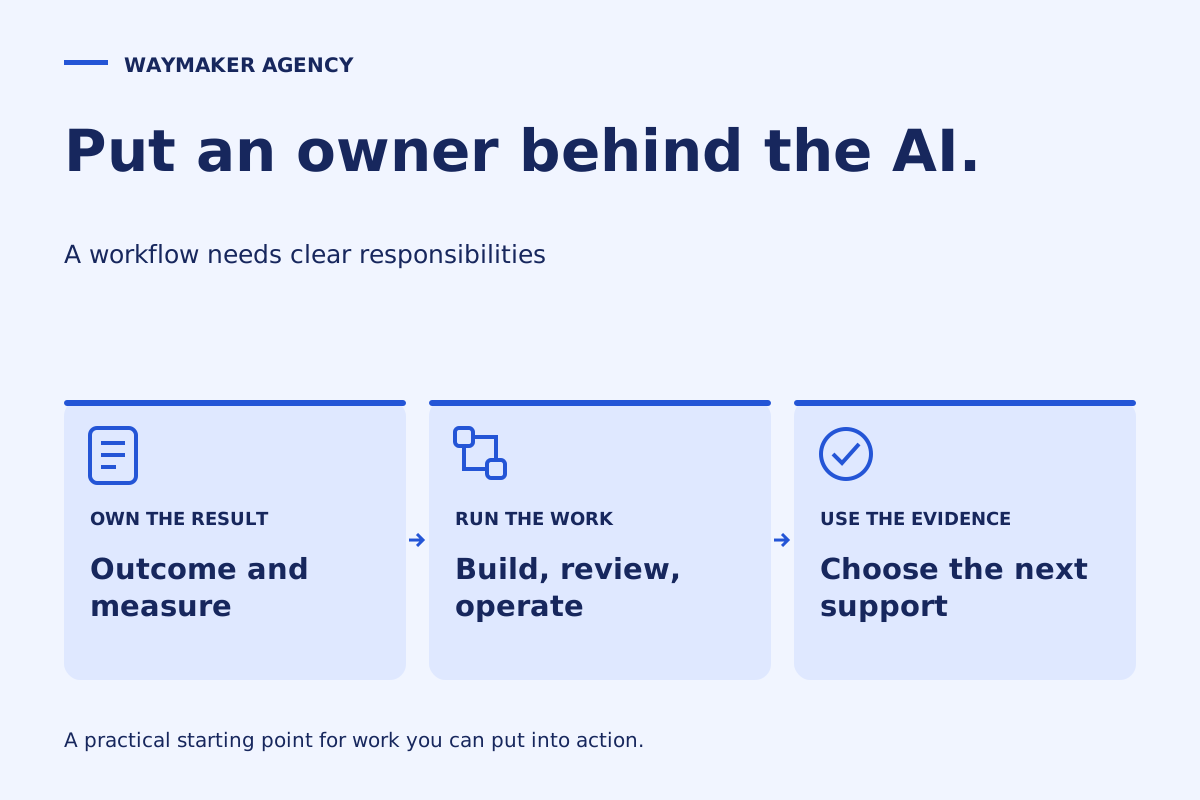
The process owner defines success and decides which exceptions matter. The builder configures the workflow and explains how it works. The reviewer checks outputs against the actual standard. The operator maintains the instructions, inputs, and connections after launch.
In a small company, one person may cover several responsibilities. Write the names down anyway. A tool subscription does not become the process owner, and an outside implementer should not silently inherit every future maintenance task.
For each responsibility, specify one deliverable. The owner supplies the acceptance criteria. The builder supplies a working process. The reviewer supplies test results and unresolved issues. The operator receives a runbook and a clear route for reporting failures.
Your four-step starting plan
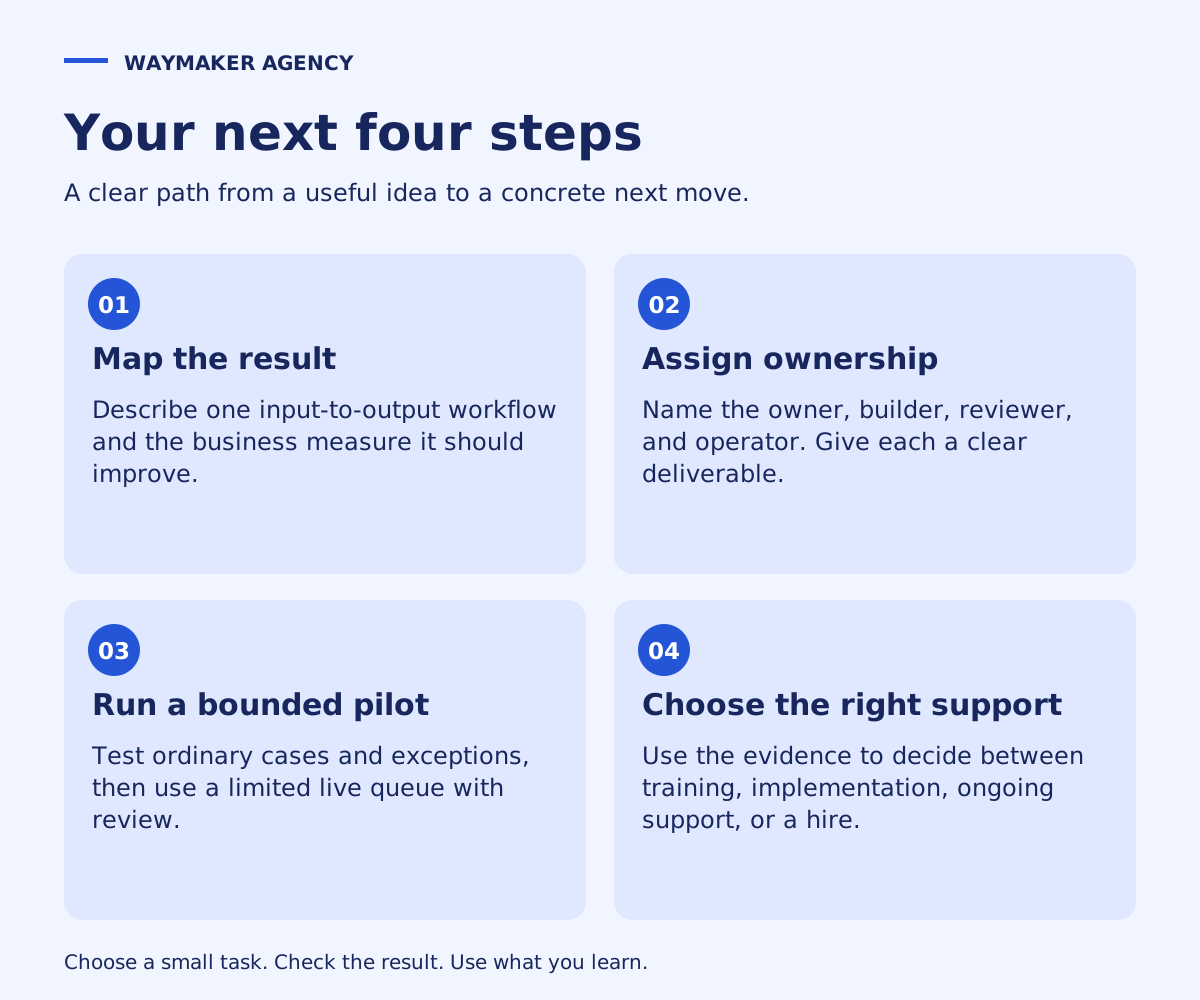
- Map the result
Describe one input-to-output workflow and the business measure it should improve.
- Assign ownership
Name the owner, builder, reviewer, and operator. Give each a clear deliverable.
- Run a bounded pilot
Test ordinary cases and exceptions, then use a limited live queue with review.
- Choose the right support
Use the evidence to decide between training, implementation, ongoing support, or a hire.
A worked example: inquiry to a reviewed first reply
Consider a service business that receives inquiries through a website form. The proposed pilot classifies the request, identifies missing details, and prepares a first reply using approved service information. The office manager approves the response and remains responsible for availability, pricing exceptions, and any promise to the customer.
The builder tests an ordinary inquiry, an incomplete inquiry, an irrelevant message, a request for an unavailable service, and a conflicting instruction. The reviewer checks whether the draft is accurate, useful, and directed to the right owner. A response that sounds friendly but invents availability fails the test.
The operator checks the queue and updates the service information when it changes. If a connection fails, the inquiry returns to the existing manual process. Now the staffing question is specific: does the team need a short implementation project, manager training, recurring operational help, or enough ongoing work to justify a role?
Use 30 days to make a better staffing decision
During the first week, document the current process and record a baseline. Pick a measure the team can observe, such as time to a reviewed response or the percentage of inquiries that reach the correct owner. Choose a quality standard as well as a speed measure.
In the second week, build the smallest workflow that can be reviewed. Run sample cases before involving live customers. In the third week, use a limited queue with the named reviewer. Record corrections and exceptions, including time spent fixing them.
In the fourth week, compare the full cost of the process: preparation, tool usage, review, maintenance, and rework. Ask whether the team wants to keep using it. Faster generation is useful only when the finished work and operating burden improve enough to justify the change.
Match the support to the gap
Choose training when the team knows the business process but needs practice using AI and checking its work. Choose implementation help when the desired output is clear but the connections or configuration are beyond the team's capacity. Consider ongoing support when the workflow changes often or requires regular monitoring.
Consider a permanent hire when the responsibility is sustained, important, and large enough to fill a real role. Define that role through the work it owns, the decisions it can make, and the evidence it should produce. Interview with a relevant work exercise and ask how the candidate would recognize failure.
Our recommendation is to finish the pilot with a one-page operating brief: outcome, owner, inputs, allowed actions, review standard, fallback, and next review date. It becomes the foundation for a stronger job description or a more precise external scope.
Sources and further reading
Sources reviewed November 11, 2026. The practical examples and service ideas are editorial recommendations, not verified vacancies.
Want this applied to your business? The current $497 Growth Fix includes three focused improvements within one customer journey: your offer, inquiry or booking step, and first reply. Review, a private working session, implementation, written handoff, and a 30-day measurement plan are included.