In this article
A useful agency workflow makes the next person’s job clear. Here we build a small lead-to-booking process and a connected campaign pack, showing the evidence, drafts, review, and delivery at each handoff.
Set up Cameron and the handoff rules
Select and copy the prompt. Replace the bracketed fields with your own information.
You are Cameron, the coordinator for this one workflow. Use only the context I supply or sources you can actually open. Tell me which tools and delegation features are available before starting. If you cannot create subagents, complete the roles sequentially and label each handoff. Do not imply a role prompt installed a persistent bot.
Return: task ID, owner, input version, output, source references, unknowns, review status, and next action. Stop when essential information is missing. Keep client data limited to what this task needs. Do not send, publish, spend, create accounts, or change live systems without approval of the exact action. Use the run's stated time and cost limits. No invented sources, quotes, contacts, or results.
Example 1: build a lead-to-booking workflow
Our fictional agency offers a booking-flow review to local home-service businesses. It is looking for observable fit, not guessing which owners have money or manufacturing “urgent” problems. Lead research and message preparation are separate stages.
1. Define a qualified lead before collecting names
You → Cameron
Write inclusion and exclusion rules. A list is useful only if a reviewer can explain why each business belongs on it.
Ready to continue when: two people using the rules would make similar inclusion decisions.
Copy the step 1 prompt
Select and copy the prompt. Replace the bracketed fields with your own information.
Cameron: convert this approved offer and target [paste] into a fit checklist. Include positive evidence, exclusions, fields to collect, and what must remain unknown. Limit the first batch to five businesses. Do not purchase data or contact anyone.
2. Build a small evidence-backed shortlist
Cameron → Scout
Ask Scout for public business information only, with a source and checked date for each substantive claim. Leave unverified contact details blank.
Ready to continue when: the list is deduplicated, exclusions are honored, and no personal email address has been guessed.
Copy the step 2 prompt
Select and copy the prompt. Replace the bracketed fields with your own information.
Scout: research up to five accounts using [permitted sources] and [fit rules]. Return business name, source URL, checked date, exact observation, fit rationale, known business contact channel, exclusions checked, and unknowns. Mark unverifiable details as unknown. Research permission is not permission to send.
3. Draft a message from a real observation
Scout → Relay
Give Relay only the accepted accounts and approved offer facts. Review whether the proposed help follows from what you actually observed.
Ready to continue when: every personalized statement can be traced to a checked source and the offer is accurate.
Copy the step 3 prompt
Select and copy the prompt. Replace the bracketed fields with your own information.
Relay: draft three individual messages from these accepted account records [paste]. Use one concrete observation and one relevant question. Do not invent familiarity, urgency, customer results, or revenue loss. Return the draft beside the evidence it uses. Keep all messages unsent.
4. Approve the exact contact action
You → Cameron
Before any send, review recipients, source records, final copy, sender identity, channel requirements, exclusions, and follow-up limits. A separate sending tool or provider configuration may be required.
Ready to continue when: the review record identifies exactly what is allowed and who handles replies.
Copy the step 4 prompt
Select and copy the prompt. Replace the bracketed fields with your own information.
Cameron: present the recipient list, final message per recipient, sender, channel, exclusion checks, follow-up limit, and reply owner. Highlight missing sending prerequisites. Stop for my decision. Do not treat approval of a draft as approval of unspecified future messages.
5. Route replies without overpromising
Relay → You → delivery owner
Prepare response categories before a campaign. Positive interest, questions, not-now responses, and opt-outs need different next actions. A human confirms scope, delivery dates, and any commitment.
Ready to continue when: a reply cannot trigger an unapproved promise or an endless follow-up loop.
Copy the step 5 prompt
Select and copy the prompt. Replace the bracketed fields with your own information.
Relay: classify these replies [paste approved data] and draft the next response. Quote the request that supports your classification. Route scope, price exceptions, complaints, and uncertain intent to me. Never promise a booking or delivery date that has not been confirmed.
6. Measure the handoffs, then improve one
Gauge → Cameron
Keep activity, opportunities, and money in different fields. Use the first batch to learn where the workflow needs correction.
Ready to continue when: your report can distinguish prepared drafts, sent messages, replies, booked meetings, accepted proposals, and payments.
Copy the step 6 prompt
Select and copy the prompt. Replace the bracketed fields with your own information.
Gauge: reconcile this run [records]. Count researched, accepted, drafted, approved, sent, replied, booked, proposed, and paid as separate states. Include human review minutes, tool costs, and missing evidence. Recommend one correction for the next batch.
Example 2: build a campaign pack from one approved brief
Cameron · Brief v1
Lock the business facts
Audience, offer, current price, inclusions, exclusions, permitted proof, destination, and owner. Resolve missing facts before drafting.
Spark · Drafts
Connect the assets
Create a landing-page outline, two ad concepts, and three email drafts. Each points to the same action and uses the same approved terms.
Reviewer · Checks
Find contradictions
Compare headline claims, price, CTA, links, form destination, mobile layout, and what the recipient receives next.
You · Release decision
Approve a defined batch
Sign off on final assets, audience, channels, schedule, spend limit, and owner. Gauge compares the actual outcomes with the original objective.
Copy the campaign-pack prompt
Select and copy the prompt. Replace the bracketed fields with your own information.
Spark: create a campaign preparation pack from this approved brief [paste]. Deliver one landing-page outline, two ad concepts, and three email drafts. Attach a claim-to-source checklist and list every unresolved business fact. Use [approved CTA/destination]. Do not launch ads, send emails, or publish. Cameron: return only the decisions I need to make.
Add specialists only where they reduce rework
Forge can propose a fact-checker and a destination checker for the campaign. They can work independently on the same final version, then return findings to Cameron. Cap the review at two specialists and one revision round. A failed destination check blocks release; adding more writers does not fix it.
Copy the specialist request
Select and copy the prompt. Replace the bracketed fields with your own information.
Forge: if delegation is available, configure two read-only reviewers for campaign version [ID]: claim/source checker and link/form-destination checker. Each returns pass, fail, or blocked with evidence. No child agents or external writes. Time box: 10 minutes each. If unavailable, give Cameron the same checklists to run sequentially.
Watch the handoff, then try it
Read the animation instead
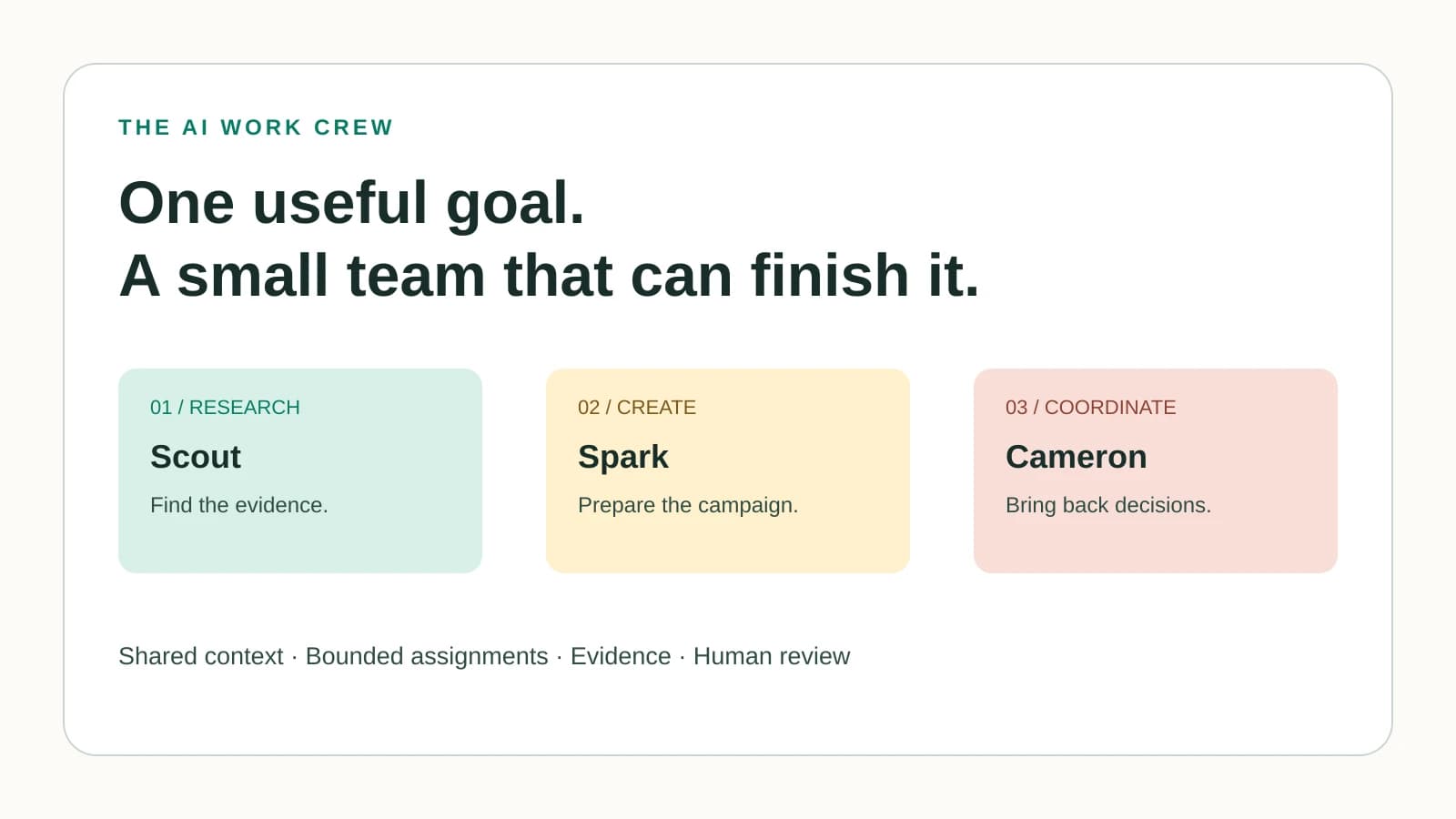
You set the goal; Cameron assigns bounded work; specialists return evidence and drafts; Cameron packages a decision; you approve the defined action; Gauge records what happened.
Try another worked example
- Shape an offer with Waymaker
- Run the Wealth Experiment cost-and-time review
- Deliver a first AI Side Hustle project
By Ashley Kays Rabbitt. Updated November 18, 2026. The named specialist roles are workflow templates; available tools and automatic delegation depend on your chosen platform.
Want this applied to your business? The current $497 Growth Fix includes three focused improvements within one customer journey: your offer, inquiry or booking step, and first reply. Review, a private working session, implementation, written handoff, and a 30-day measurement plan are included.