In this article
The campaign report is finished. The decision it was supposed to support still is not. Someone needs to reconcile the numbers, find the landing page, check what changed, and explain what the client should do next. That unfinished handoff is a good place to start using AI agents.
An agent can carry out a sequence of tasks using available tools. The management work is deciding what it should produce, what information it can use, and how another person will judge the result. For an agency, the first useful experiment is a bounded piece of delivery that happens often enough to improve.
Start with one weekly conversion review
Consider a weekly review for a single lead-generation landing page. Give the workflow a dated analytics export, the current page, the campaign brief, and the previous recommendation. Its output is a short decision memo: what changed, what might explain it, and which experiment deserves attention.
Keep observations separate from explanations. A lower conversion rate is an observation. The belief that a longer form caused it is a hypothesis until other evidence supports it. An agent that blurs those categories can produce a persuasive memo that sends the team toward the wrong fix.
| Work | Useful output | Acceptance check |
|---|---|---|
| Reconcile inputs | Comparable periods and metric definitions | Totals match the supplied exports |
| Inspect the experience | Dated observations from the page | Each claim names a visible element or source |
| Propose a change | One experiment with a reason | Success measure and owner are specified |
| Review the handoff | Decision memo with unresolved questions | Client-facing claims are supported |
Give the assignment a finish line
Review the supplied landing page and weekly exports for one client.
Create a decision memo of no more than two pages.
Use the same reporting period and conversion definition throughout.
Separate observed facts, possible explanations, and missing information.
Recommend one experiment; include the evidence, effort, owner, and metric.
Attach the source references and any relevant page captures.
You may inspect inputs and create working files.
Leave live campaigns, page changes, and client messages for my review.
If a source is inaccessible, identify the gap and continue with supported work.
That brief turns a broad request into a deliverable someone can accept or reject. It also prevents an attractive slide deck from substituting for the decision the client needs.
Keep the task record small enough to use
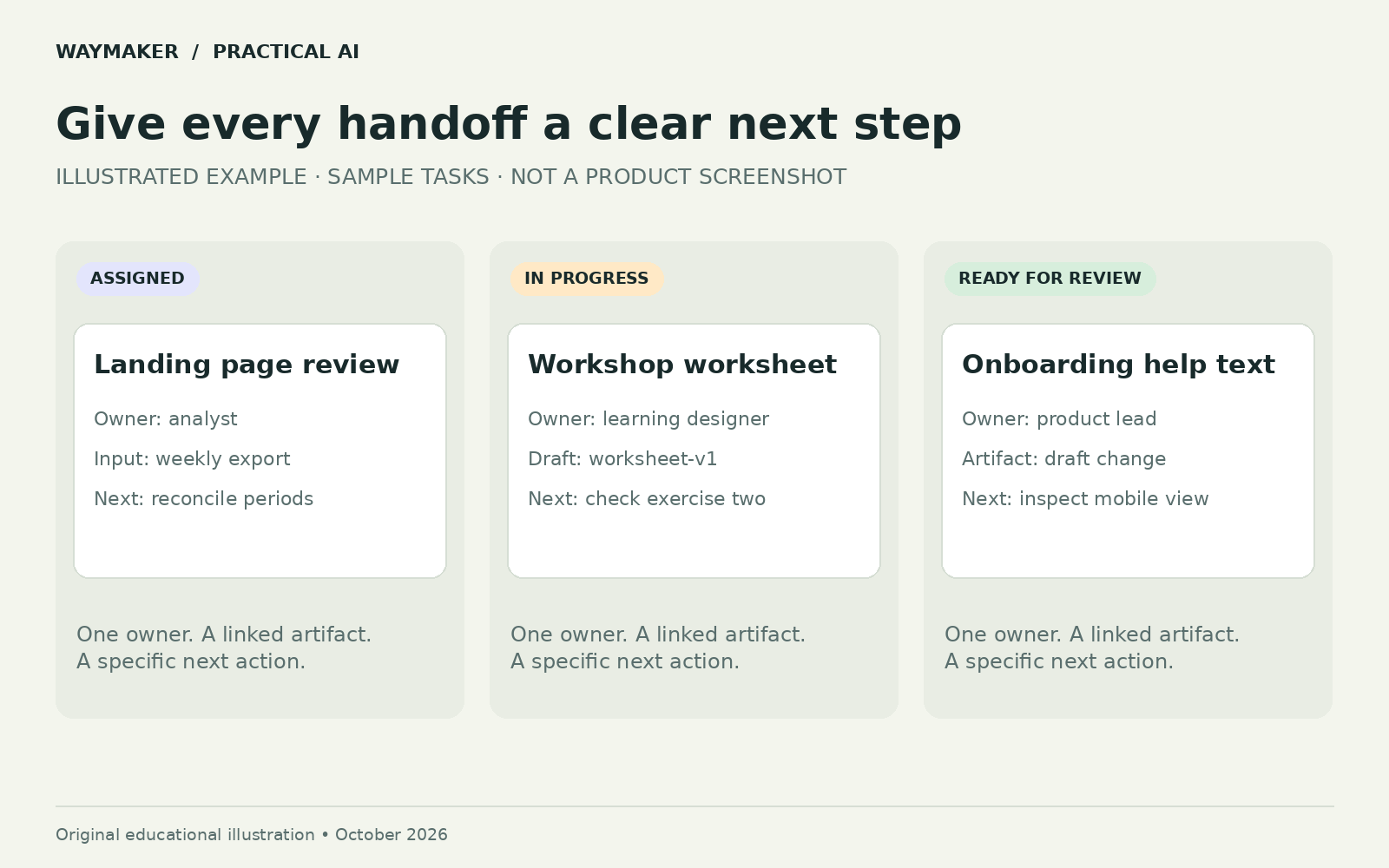
One shared row can be sufficient: task, owner, current stage, artifact, blocker, and next decision. Give each task one current owner. Two people can contribute, but someone needs to be responsible for the next handoff. If the review fails, record the specific correction beside the file it concerns.
Use four working stages: assigned, in progress, ready for review, and accepted. Add blocked when progress depends on missing access or a decision. These labels describe your process; they do not automatically enforce it. Your project tool, file permissions, and review practice must support the rules.
Use tools where they fit the work
A proposed setup is to give Dot responsibility for coordination, use Work for the report, and bring in the browser extension when a necessary step depends on a signed-in page. This is a workflow design to test in your account. See the companion setup guide for verified capabilities and connection requirements.
Prefer a structured export or a suitable connected integration for repeated data collection. Use page inspection for the parts that are visual: a misplaced button, an unclear claim, or a form that does not behave as expected. A screenshot supports what was visible at that moment; it cannot establish why a metric changed.
Make review a separate activity
Ask the reviewer to compare the memo with the brief and the original evidence. Can the totals be reproduced? Does the recommendation address the actual friction? Is there a plausible alternative explanation? If another AI pass is used, provide the underlying files, not just the first agent’s summary. A fresh pass can still repeat an error, so important decisions retain a human owner.
The most useful review note is specific: “The report compares seven days with six days; recalculate before interpreting the change.” “Looks good” tells the delivery team very little.
Measure the cost of accepted work
For a pilot, track preparation time, review time, correction time, tool spending, and whether the memo was accepted. Compare those with a manual baseline. If drafting becomes faster while corrections double, the workflow needs better inputs or a smaller assignment. Also track repeated defects: missing citations, inconsistent periods, and recommendations that ignore business constraints.
Run the same process on three comparable briefs before adding a schedule. That is our suggested pilot size, not a performance guarantee. The objective is to find a repeatable way of finishing useful work, with a clear owner when something needs judgment.
What the team still owns
Account leaders own the commercial promise. Strategists decide which question matters. Designers assess the experience in context. Analysts challenge interpretations. AI can help prepare the materials for those decisions, but the agency’s value remains its ability to make and defend them.
Choose one delivery bottleneck to work through together. Explore Waymaker Agency’s custom team training.
Companion guide: how Dot, Work, and browser access fit together.
Want this applied to your business? The Growth Fix is one fixed-price session to find where your customers drop off and fix the part that matters most.