AI leadership
Lead AI adoption with one useful pilot your team can trust
Create a practical AI adoption pilot with a real workflow, explicit quality criteria, supported learning, and accountable decisions.

In this guide
- The useful starting point
- Choose a workflow people recognize
- Define the pilot agreement
- A fictional pilot: customer onboarding briefs
- Teach the task and the judgment together
- Use this pilot-planning prompt
- Measure accepted work rather than activity
- Create a learning loop people will use
- Decide how to proceed
- Questions you might be asking
- Sources and further reading
The useful starting point
Choose one meaningful workflow, involve the people who do it, and define the quality, access, and review boundaries before testing AI. Measure total effort and accepted work, then expand only when the pilot demonstrates a useful, maintainable improvement.
Teams do not need another instruction to “use more AI.” They need a clear reason, a practical place to start, and permission to report when the tool makes work harder. Leadership turns curiosity into a useful working method.
A good adoption pilot combines a real business need with a manageable learning experience. It helps people understand where AI can assist, where human judgment remains essential, and how to inspect the result.
Choose a workflow people recognize
Start with a recurring task that has a clear owner and output. Examples include preparing a project brief, summarizing approved research, checking a handoff, or drafting an internal status report.
Avoid choosing only because the demonstration looks impressive. Ask the people doing the work where time is lost, where quality varies, and where information arrives incomplete. Their experience may point to a simpler process improvement than the one leadership imagined.
Write the pilot's purpose in terms of work completed well. “Improve the clarity and turnaround of reviewed project briefs” is more useful than “increase AI usage.”
Define the pilot agreement
| Decision | What to make explicit |
|---|---|
| Scope | The task, team, inputs, and outputs included |
| Quality | Acceptance criteria and critical errors |
| Access | Approved tools, data, and permitted actions |
| Review | Who checks the result and owns the decision |
| Learning | How failures, corrections, and useful practices are recorded |
| Next step | Conditions for expansion, revision, or stopping |
Keep the agreement understandable. A team member should know what they may try, what they must check, and where to ask for help without interpreting a long technical document.
A fictional pilot: customer onboarding briefs
Imagine a service team that prepares onboarding briefs from sales notes. The current process varies by person, and delivery colleagues often ask for clarification.
The pilot uses an approved assistant to draft a brief from a standard input template. It separates confirmed scope, customer goals, open questions, and proposed next steps. A delivery lead reviews the result before it is used.
The team compares a small set of representative briefs with the existing process. It records preparation time, review time, missing commitments, unsupported claims, and the number of follow-up questions required. These are illustrative measures, not reported client results.
Early attempts may reveal that the input template is the main problem. Improving the capture of sales commitments could benefit the team regardless of which AI tool it uses. That is a valuable pilot finding, even if it changes the original implementation plan.
Teach the task and the judgment together
A useful training session should include an actual piece of work, a flawed output, and a review exercise. Participants need to practice spotting omissions and unsupported assumptions, not only watching a successful demonstration.
Show how to provide context, define done, ask for alternatives, and request evidence. Explain which decisions the assistant cannot make on the team's behalf. Give people a way to correct or reject an output without feeling that they have failed at adoption.
Do not promise that learning a tool makes anyone immune to job change. Build relevant capabilities: domain understanding, clear problem definition, evaluation, communication, and accountable execution. These skills help people contribute as the tools evolve.
Use this pilot-planning prompt
Help us plan a small AI adoption pilot for [workflow]. Use the current process and constraints below. Define the intended outcome, representative cases, acceptance criteria, approved inputs, review owner, and stop conditions. Include a practice exercise with an intentionally flawed output. Propose measures that count review and rework, not just generation speed. Identify what would make us choose a simpler process instead.
Review the proposed plan with the people who will use it. Ask what feels unrealistic, what information is missing, and which consequence worries them most. That discussion often improves the design before any integration is built.
Measure accepted work rather than activity
Usage counts can show participation, but they do not establish value. Look at whether work meets the acceptance criteria, how much correction it requires, and whether the complete process improves.
Compare similar cases where possible and record differences that could affect the result. Do not claim a broad productivity gain from one easy example. Keep the limits of a small pilot visible.
Collect qualitative feedback too. Does the workflow make responsibilities clearer? Does review feel manageable? Can someone recover from a failed run? A process that depends on one enthusiastic expert may need simplification before wider use.
Create a learning loop people will use
- Run a realistic task with approved material.
- Inspect the result against the agreed criteria.
- Record one useful practice and one failure or uncertainty.
- Improve the input, instruction, or process responsible.
- Repeat a saved test before expanding the scope.
Give the team a small shared collection of examples and checks. Keep it maintained by an owner rather than allowing it to become an unsearchable pile of prompts.
Decide how to proceed
Expand when the workflow is useful, understandable, and supportable within the agreed boundaries. Revise when errors are fixable through clearer inputs or a better review step. Stop when the cost, risk, or complexity outweighs the benefit.
Leadership shows up in that decision. Treating every experiment as a success discourages honest reporting. A team that can explain what worked, what failed, and what it will try next has learned something durable, even when the first tool is not the right fit.
Questions you might be asking
What should we measure in an AI pilot?
Measure accepted output quality, total effort including review and rework, important errors, and operational fit. Usage alone is not evidence of a useful improvement.
How do we help skeptical team members?
Invite them to identify real constraints and failure cases. Use a bounded task, visible review criteria, and a practical way to reject or correct results.
When should we expand the pilot?
Expand when representative cases meet the agreed criteria and the workflow has clear ownership, permissions, recovery, and manageable review effort.
Sources and further reading
- Microsoft appropriate reliance research
- Microsoft human-AI interaction guidelines
- Anthropic evaluation guidance
Sources checked October 16, 2026. Tool features and plan availability can change; review the linked publisher documentation before connecting an account.
Put one idea to work
Bring one recurring workflow, its sources, and a clear owner to a focused implementation conversation.
Explore practical AI training →Explore more from Waymaker AgencyKeep practicing
 Agile delivery
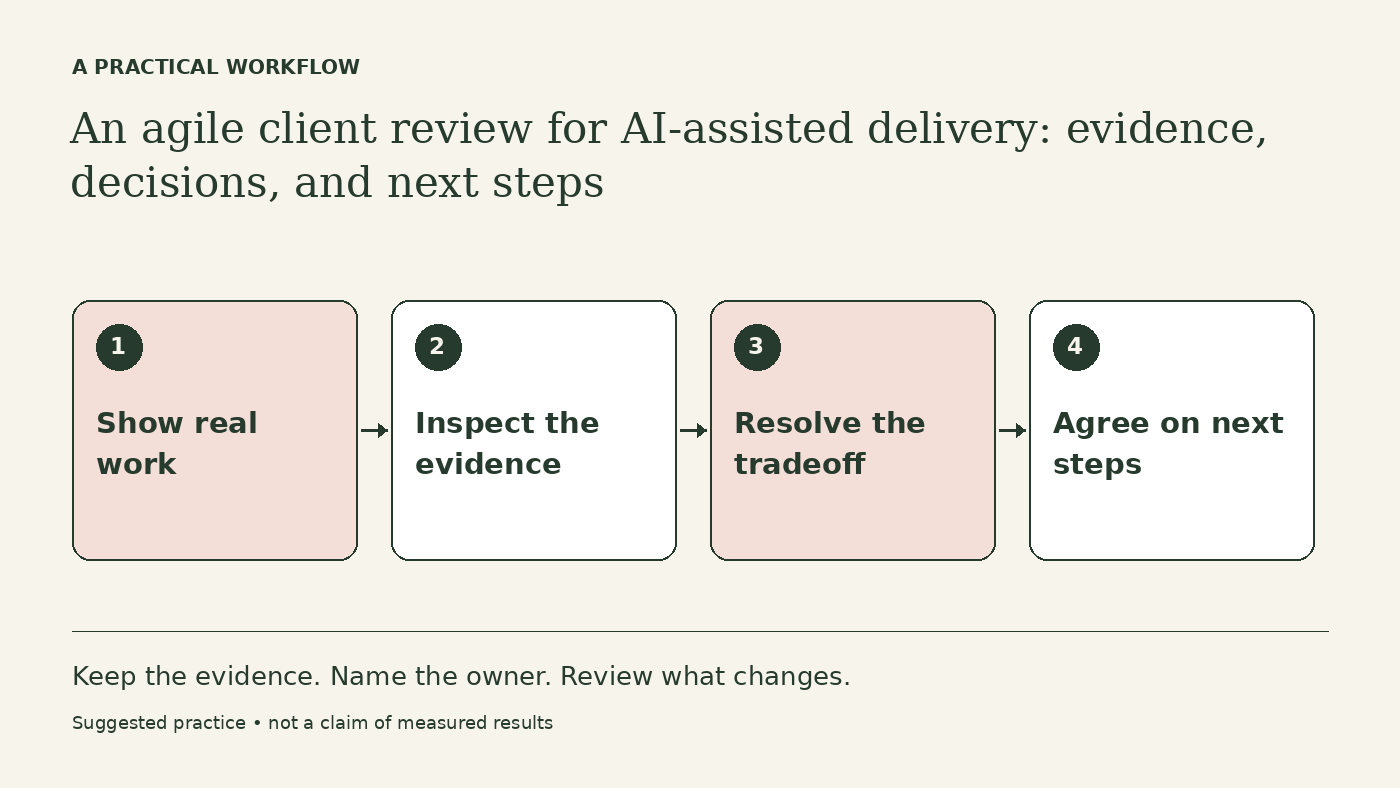
An agile client review for AI-assisted delivery: evidence, decisions, and next steps
Use a practical weekly review to keep client outcomes, design, engineering, and product decisions connected as delivery accelerates.
October 16, 2026 · 5 min read AI implementation
Is your business data ready for connected AI?
Assess a connected AI workflow through decision clarity, data definitions, permissions, review ownership, and a small verifiable pilot.
October 16, 2026 · 5 min read