
What does forward deployed design mean for a business?
Forward deployed design places a designer close to the team using or implementing a product. The designer learns the actual workflow, helps shape and test the experience, partners with implementation, and turns what the engagement teaches into reusable improvements. The useful unit of work is a customer outcome with an owner, rather than an open-ended supply of screens.
The term is appearing in real employer roles, including product implementation at Tailor and customer-facing creative work at Hightouch. It is still used differently across organizations. For a buyer, the contract and operating model matter more than whether a supplier uses the title.
When an embedded approach can help
Consider it when a product works in a demonstration but adoption stalls inside a real organization. The gap may involve confusing roles, exception handling, missing context, or a handoff between systems. A designer close to the people doing the work can help uncover and test those problems with the implementation team.
Other useful situations include a new customer workflow with several stakeholders, an AI-assisted process that needs human review and recovery, or a rollout where customer-specific requests need to become a consistent product pattern. The approach depends on access to the work and a team capable of acting on the findings.
It is a poor fit when nobody can make decisions, users cannot participate, or the assignment is simply an unlimited backlog of production requests. In those situations, start by resolving ownership or agreeing a narrower delivery service.
Match the specialist to the actual constraint
| Main constraint | Likely first conversation |
|---|---|
| People cannot understand or complete the workflow | UX or forward deployed designer |
| Systems cannot exchange the necessary data reliably | Integration or forward deployed engineer |
| The buyer or problem is unclear | Product discovery or customer research lead |
| The offer attracts unsuitable customers | Positioning and marketing strategist |
| The workflow is understood and needs visual production | Product or creative production designer |
Complex work may need more than one discipline. Do not expect a job title to replace engineering review, customer research, security decisions, or accountable product ownership. The goal is to remove the relevant constraint with the smallest effective team.
Write a one-workflow engagement brief
Name the customer group and the task they need to complete. Identify the current evidence, the business consequence of the problem, and the decisions the engagement should enable. Describe the systems, environments, and permissions involved without sharing sensitive credentials in the brief.
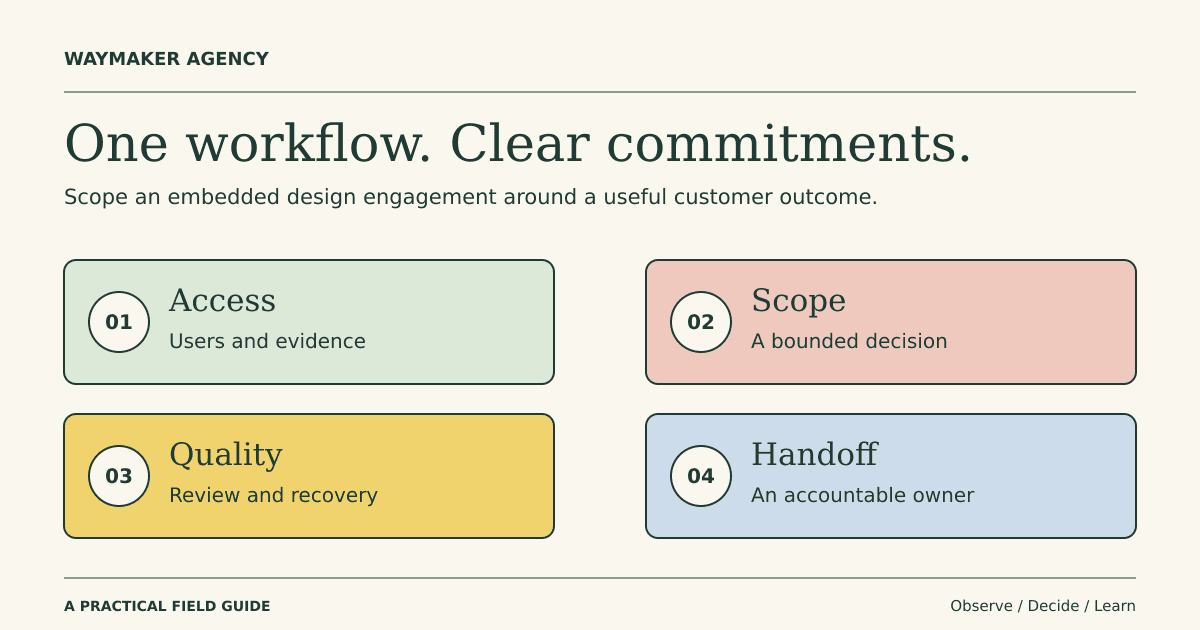
Agree four commitments before work begins:
- Access: who can be interviewed or observed, which data can be used, and how access is approved.
- Scope: the workflow, included states, deliverables, dependencies, and change process.
- Quality: how usability, accessibility, content, implementation, and failure recovery will be reviewed.
- Handoff: the operating owner, documentation, training, support boundary, and review date.
These are planning prompts, not a ready-made legal agreement. Your commercial terms and data responsibilities need to fit the actual engagement. A useful brief makes responsibilities visible enough for both sides to estimate the work honestly.
A sample delivery sequence
Illustrative engagement: a service business wants staff to move a qualified inquiry into a booked consultation without losing the customer's context. The initial scope covers one intake route, one handoff, and the confirmation experience.
First, observe representative cases and map the current process, including exceptions. Next, choose the highest-impact uncertainty and prototype an alternative. Test the proposed flow with the people who will use it. Partner with the implementation owner to check the delivered behavior, then document operations and inspect the first permitted usage data.
A calendar alone is not the success measure. Ask whether the right inquiries reach the right person, whether customers understand the next step, and whether staff can recover when a booking or delivery fails. The work may reveal that clearer ownership is more valuable than another interface.
Measure an outcome without inventing causality
Start with a baseline tied to the task: completion, time to a useful outcome, avoidable rework, or a defined error rate. Pair that with a business measure and a guardrail. For an inquiry workflow, track qualified bookings alongside customer understanding and inappropriate or duplicate submissions.
Record what changed at the same time. New traffic, staffing, training, or pricing can affect the result. A before-and-after improvement is evidence to interpret, not automatic proof that the design caused all of the change. If the sample is small, report the observed cases and limitations plainly.
Keep customer delivery connected to the product
After each review, classify the learning: a general product issue, a configurable preference, a domain-specific requirement, or a one-off request. Give the core product owner evidence and a recommendation. Avoid quietly turning every customer exception into permanent complexity.
The final package should include the tested workflow, decisions and tradeoffs, known limitations, implementation notes, a quality checklist, and ownership after handoff. A good engagement leaves the customer more capable of operating the system.
Questions buyers should ask
Is forward deployed design the same as staff augmentation?
It can use an embedded staffing model, but the useful scope includes a defined customer problem, delivery responsibilities, and a learning loop into the product. Buying hours alone does not establish those outcomes.
Can one person own design and engineering?
Sometimes, if their demonstrated skills and the scope support it. Confirm who can approve, review, deploy, and maintain changes. One capable person still needs clear boundaries and appropriate review.
What should we bring to the first conversation?
Bring one workflow, the people affected, current evidence, important constraints, and the decision you need to make. Explore Waymaker Agency and the portfolio to discuss the relevant experience and an appropriate scope. Availability, deliverables, and pricing are agreed for the actual engagement.
Sources and related learning
- Tailor’s customer-implementation design role
- Hightouch’s customer-facing creative design role
- Build PPC expertise around business decisions
Employer examples checked October 14, 2026. The engagement framework is Waymaker Agency editorial guidance, not a claim of a client result.
Want this applied to your business? The Growth Fix is one fixed-price session to find where your customers drop off and fix the part that matters most.
