
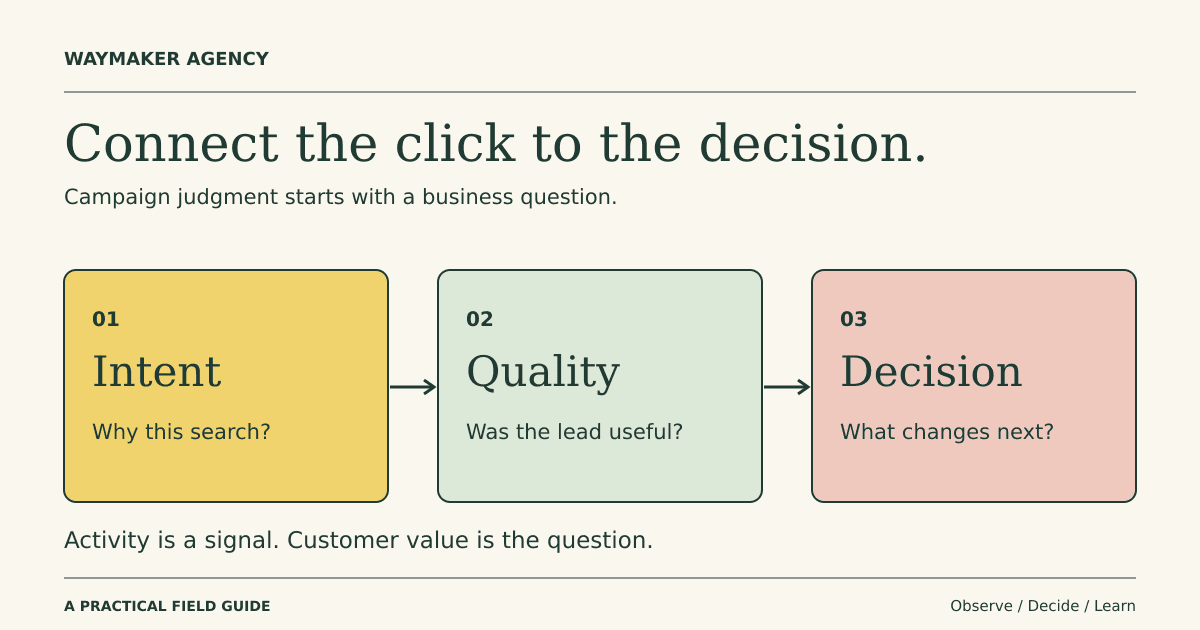
Paid-media expertise shows up in the decisions a team can explain: why this audience, why this search, why this offer, and what evidence would justify spending more. Knowing where the buttons live helps. Understanding the journey from intent to a profitable customer makes that knowledge useful.
For a business owner or marketing leader, the strongest way to develop that judgment is to work through a live offer with a clear review process. The framework below can guide an internal team, a founder managing an agency, or a practitioner building deeper capability.
Begin with a business brief that constrains the campaign
Choose one audience, one buying situation, and one offer. A persona becomes useful when it describes a decision: what happened, what the buyer needs now, what alternatives they are considering, and what might stop them. Age and job title alone rarely answer those questions.
For an illustrative commercial-cleaning campaign, “office managers” is only a starting label. “An office manager replacing an unreliable provider before a lease renewal” gives the team a problem, a timeline, and objections to investigate. Do not assume those details are true; confirm them in customer conversations and sales notes.
Practice: write a one-page brief with the buyer, trigger, promised result, proof available, exclusions, geographic scope, next action, and delivery capacity. Ask a colleague to explain the offer back without your help.
Build an intent map before a keyword list
Group search ideas by the job the buyer is trying to do. “Office cleaning checklist” could support useful educational content. “Commercial cleaning quote near me” may be closer to choosing a provider. “Cleaning jobs” usually belongs outside a campaign selling cleaning services. These are hypotheses to inspect, not researched volume or cost estimates.
For every cluster, record the likely intent, offer fit, page required, and unwanted interpretations. Then research demand and costs. Read the actual search results: are searchers being offered providers, instructions, jobs, products, or comparison pages?
Google’s match types consider meaning and intent; even exact match is not a promise of identical wording. Monitor actual search terms and use carefully chosen exclusions. A negative keyword that is too broad can remove useful prospects along with unwanted searches.
Practice: classify 20 possible queries as buy, compare, learn, or irrelevant. Defend five inclusions and five exclusions. A long list is less valuable than a short list with clear reasoning.
Make the ad and destination answer the same question
An ad promising an office-cleaning quote should lead to a page that explains service coverage, what affects the quote, the next step, and why the provider is credible. A general homepage can force the visitor to repeat the search inside your website.
Write distinct messages around the customer problem, the offer, verifiable evidence, and the next action. Review combinations for accuracy and clarity. Avoid unsupported superlatives, invented savings, and urgency that the business cannot justify.
Practice: place the search query, ad, and first screen of the landing page side by side. Underline the shared promise. Then try the page on a phone and complete the form yourself. Record unclear wording, unexpected fields, broken states, and what the confirmation actually promises.
Teach measurement before bidding
Agree on what counts as a lead, a qualified lead, a sale, and a repeat customer. A downloaded checklist and a booked sales conversation should not silently become equivalent business outcomes.
In Google Ads, primary actions can guide bidding when their standard goal is selected; secondary actions generally support observation. Custom goals are an exception and can use included secondary actions for bidding. Inspect the actual configuration rather than relying on labels alone.
Test the whole path: successful submission, duplicate event prevention, campaign identification, consent behavior, CRM arrival, sales disposition, and revenue recording. Share only the customer data appropriate for the task and use approved tools.
Learn the economics with a worked example
Suppose a campaign spends $1,200, receives 300 clicks, generates 24 inquiries, produces eight qualified opportunities, and wins two customers. These are illustrative numbers.
- Cost per click: $1,200 ÷ 300 = $4.
- Inquiry conversion rate: 24 ÷ 300 = 8%.
- Cost per inquiry: $1,200 ÷ 24 = $50.
- Cost per qualified opportunity: $1,200 ÷ 8 = $150.
- Advertising cost per new customer: $1,200 ÷ 2 = $600.
If the team reports only the $50 inquiry cost, leadership cannot judge affordability. Compare the $600 media cost with contribution after delivery costs, then include sales effort, creative production, management fees, and the time until payment. Report those cost definitions explicitly.
Use a weekly review to develop judgment
- Verify: is tracking working, and have delayed conversions had time to appear?
- Explain: which searches, messages, or journey steps account for the change?
- Choose: what is the highest-value uncertainty to resolve?
- Test: specify one main change, a success measure, a budget boundary, and a review point.
- Document: record the outcome, alternative explanations, and the next decision.
A tracking failure or clearly irrelevant traffic warrants prompt action. A modest performance fluctuation may need more observation. There is no universal number of clicks or days that proves every campaign successful or unsuccessful.
Use AI as a reviewer with an evidence boundary
Give an AI assistant an anonymized brief and exported search terms. Ask: “Group these queries by likely buying intent. Quote the supporting query for each group. Separate observations from assumptions. Flag exclusions that might also block qualified buyers. Do not invent volumes, costs, or results.” Review the output before changing anything.
For team development, pair official platform study with these five deliverables: a brief, intent map, ad-to-page review, measurement specification, and decision log. Certifications can check platform knowledge; these artifacts show how someone applies it.
Put the framework to work on one campaign
Choose a campaign and bring its offer page, available results, and one unresolved question. Use the PPC services and free audit options to explore support, or start with the service-buying intent guide. A useful audit should lead to prioritized decisions with clear scope and evidence.
Official learning resources
- Google Skillshop: Search and Measurement training
- Google Ads: keyword matching options
- Google Ads: primary and secondary conversion actions
- Google Analytics Academy
Platform references reviewed October 14, 2026. Exercises and numerical scenarios are original teaching examples, not campaign results or vendor guarantees.
Want this applied to your business? The Growth Fix is one fixed-price session to find where your customers drop off and fix the part that matters most.
