Embedded delivery
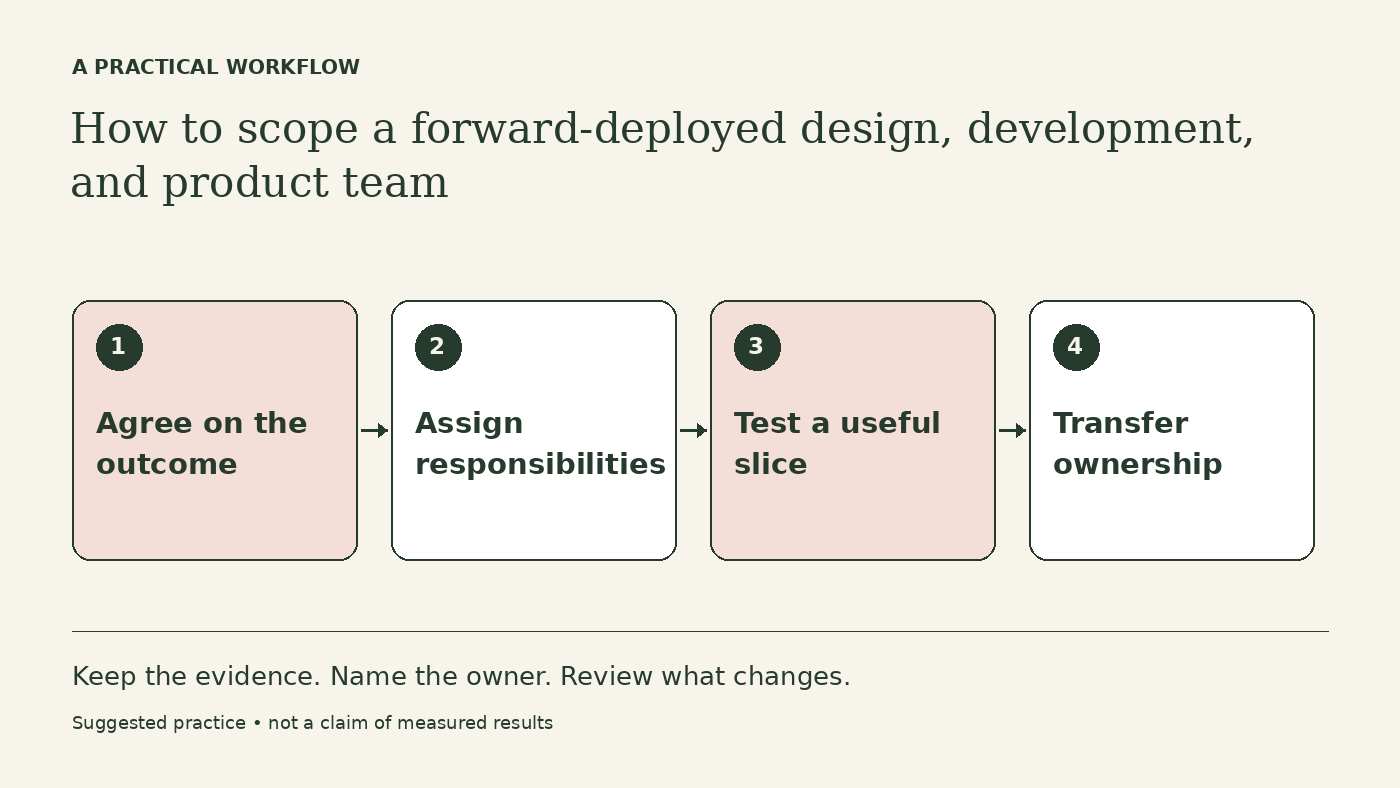
How to scope a forward-deployed design, development, and product team
Turn an ambiguous client implementation into a bounded engagement with clear responsibilities, evidence, and a useful handoff.
In this guide
- The useful starting point
- Scope the customer outcome first
- Assign responsibilities around uncertainty
- A worked example: renewal preparation
- Agree on acceptance and exclusions
- Use a deployment charter
- Finish with capability transfer
- Continue with a related guide
- Questions you might be asking
- Sources and further reading
The useful starting point
Start with the client outcome and the main uncertainty. Assign design, engineering, and product responsibilities accordingly, agree on decision rights, and define the evidence and handoff required before the engagement expands.
A client may ask for an AI tool when the real obstacle is an unclear workflow. Another may ask for a redesign when the underlying data cannot support the experience. An embedded engagement works best when the team can investigate that gap and act on what it learns.
Forward-deployed design, engineering, and product roles exist in different forms across employers. Gamma, Palantir, and Scale AI provide examples of customer-facing responsibilities in those disciplines. The operating model below is our proposed scoping approach, not a claim that every company organizes the roles this way.
Scope the customer outcome first
Describe the task people need to complete, the current friction, and what evidence would show improvement. Name the client sponsor and the person responsible for the day-to-day process. Confirm access to users, source material, and relevant systems before promising a delivery schedule.
A useful scope might be helping account managers prepare an accurate renewal brief from approved records. Build an AI platform is too broad to establish a practical acceptance test.
Assign responsibilities around uncertainty
Design owns investigation of the experience and the interaction decisions. Engineering owns implementation, integration, and system behavior. Product connects the outcome to priorities, tradeoffs, and the boundary between a local solution and a reusable capability.
These responsibilities may be covered by fewer than three people, depending on the scope. Keep the boundaries explicit even when one person wears several hats. Identify decisions that require the client, such as changing a policy or approving a customer-facing promise.
A worked example: renewal preparation
Imagine a hypothetical client whose account managers prepare renewal meetings from CRM records and support notes. The sponsor asks for an automated presentation. Observation reveals that account managers disagree about which commitments are current.
The product lead defines the decision the brief should support. Design creates a reviewable layout that separates verified commitments, open issues, and proposed next steps. Engineering connects approved sources and preserves links back to the records.
The team pilots a draft-only brief on a small set of accounts. Account managers check factual accuracy and whether the brief helps prepare the conversation. The client decides whether the source records need cleanup before more automation is useful. No presentation is sent automatically during this pilot.
Agree on acceptance and exclusions
Specify the eligible cases, required source references, quality checks, review owner, and failure path. Include what the team will not deliver within this scope: unsupported integrations, a complete CRM migration, or unrestricted autonomous communication, for example.
These exclusions are commercial clarity, not fine print. They help the client understand which problem the engagement can resolve and what a later phase would require.
Use a deployment charter
Client task: [task]. Intended outcome: [observable progress]. Evidence: [current examples]. Responsibilities: [design, engineering, product, client owner]. Constraints: [systems and policies]. Acceptance: [quality and behavior]. Exceptions: [handoff]. End state: [who operates and maintains it]. Identify unknowns before estimating additional work.
Finish with capability transfer
Deliver the implemented workflow, decision log, source definitions, operating instructions, and unresolved issues. Ask the receiving team to run a normal case and a failure case. Confirm ownership of updates and support.
For the design-specific buying decision, see when to bring a forward-deployed designer into a client team. The goal of an embedded engagement is useful delivery and a team that can continue with confidence.
Continue with a related guide
- From process evaluation to a useful automation pilot
- Lead AI adoption across product, marketing, and delivery
Questions you might be asking
Does every engagement need three specialists?
No. Scope the responsibilities first, then choose staffing based on complexity, risk, and the expertise required.
How do we prevent endless custom work?
Agree on the outcome, acceptance criteria, exclusions, change process, and long-term ownership before delivery begins.
Sources and further reading
- Gamma: Forward Deployed Designer role
- Palantir: engineering role distinctions
- Scale AI: Forward Deployed Product Manager, Enterprise
Sources checked October 16, 2026. Tool features and plan availability can change; review the linked publisher documentation before connecting an account.
Put one idea to work
Bring one recurring workflow, its sources, and a clear owner to a focused implementation conversation.
Explore practical AI training →Explore more from Waymaker AgencyKeep practicing
 AI implementation
Is your business data ready for connected AI?
Assess a connected AI workflow through decision clarity, data definitions, permissions, review ownership, and a small verifiable pilot.
October 16, 2026 · 5 min read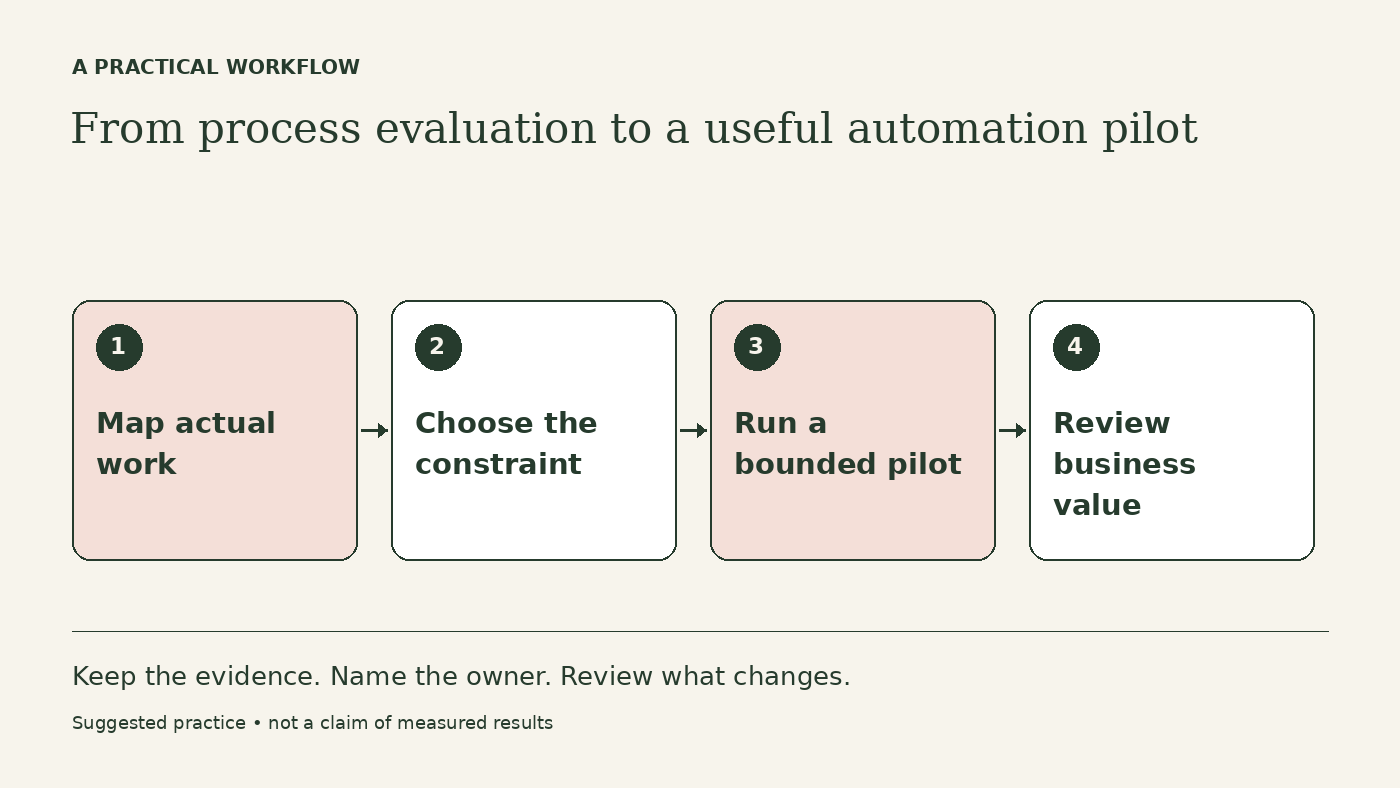 Automation implementation
From process evaluation to a useful automation pilot
A practical method for finding workflow friction, selecting the right intervention, and proving whether an automation helps.
October 16, 2026 · 4 min read