AI leadership
Lead AI adoption across product, marketing, and delivery
Create a shared operating agreement so AI improves handoffs, decision quality, and team capability across functions.
In this guide
- The useful starting point
- Pick a handoff that matters
- Define decision rights in plain language
- A worked example: selling a new service
- Coach judgment, not just prompting
- Evaluate the whole system
- A leadership workshop prompt
- Turn the pilot into a maintained practice
- Continue with a related guide
- Questions you might be asking
- Sources and further reading
The useful starting point
Choose a cross-functional customer outcome, define shared evidence and decision rights, pilot one handoff, and coach people through the change. Measure the complete workflow and keep leaders accountable for commitments.
AI adoption can look successful inside each department while the customer experience becomes less coherent. Marketing drafts a stronger promise, product generates a feature concept, and delivery receives a commitment it cannot fulfill. Each team worked faster; the handoff became weaker.
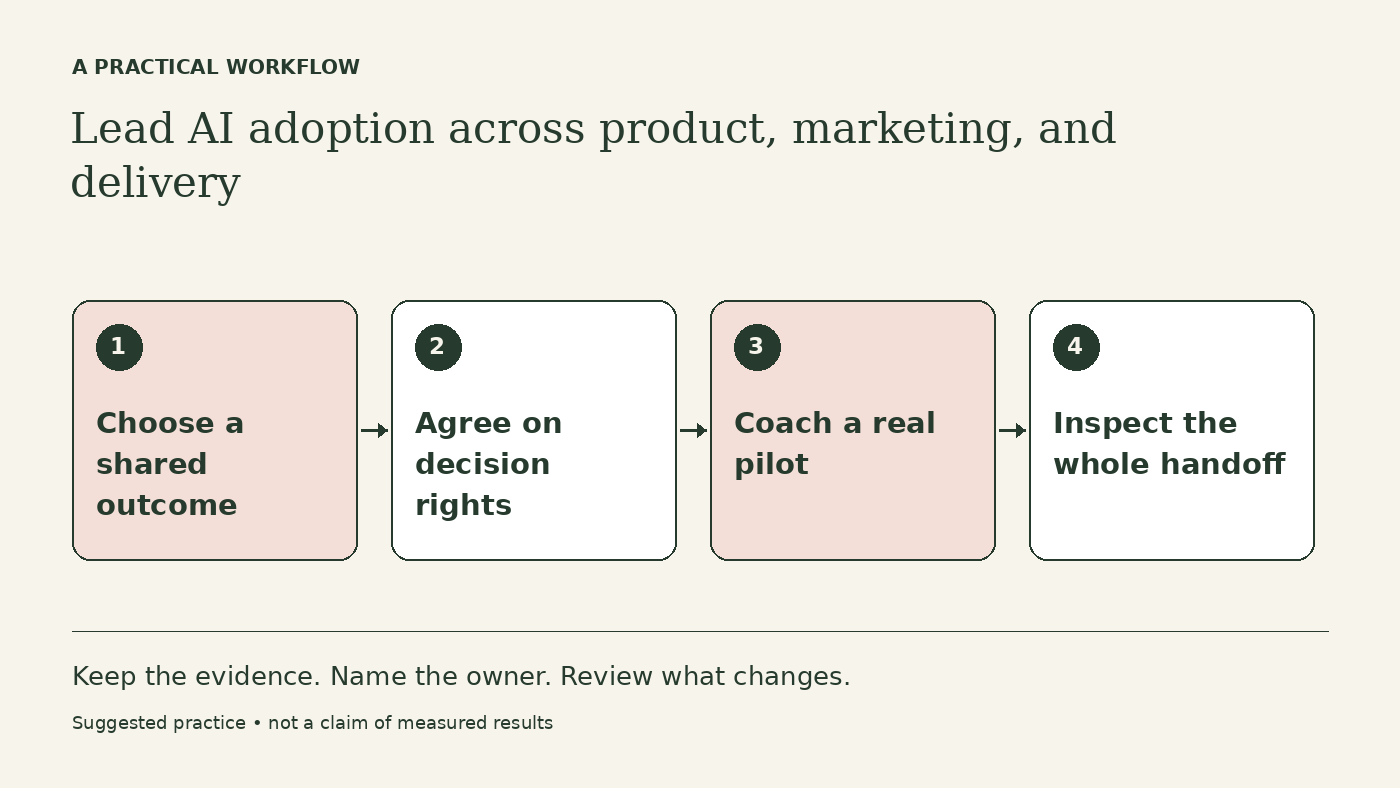
Leadership should begin with a shared customer outcome and an agreement about how decisions move between teams. Tool selection follows that agreement.
Pick a handoff that matters
Choose a moment where misunderstanding creates real work: campaign to sales, sales to delivery, research to product, or implementation to support. Follow several recent examples and ask what each side believed had been agreed.
Record the source of truth for scope, customer needs, dates, and success criteria. If different systems disagree, assign someone to resolve the meaning before automating a summary. AI can make a contradiction sound coherent without making it disappear.
Define decision rights in plain language
Specify who may propose a change, who verifies the evidence, and who approves a commitment. A marketing draft can suggest a benefit, but the delivery owner must confirm that the service can provide it. A product summary can propose a roadmap opportunity without promising a date to a client.
Make the agreement visible to the people doing the work. Avoid a policy document that only leadership reads. Include examples of acceptable assistance and cases that require a conversation.
A worked example: selling a new service
Imagine a hypothetical company introducing an AI-assisted reporting service. Marketing wants a compelling promise, product wants a reusable workflow, and delivery needs to know which data sources each client can provide.
The leaders agree that the initial offer produces a reviewed decision brief from a defined set of sources. Marketing uses that scope in the page. Sales confirms source availability during qualification. Delivery uses a checklist that records missing access and metric definitions before work begins.
AI helps prepare drafts at each stage, but all teams use the same approved offer record. A requested exception returns to a named owner rather than quietly appearing in the delivery task. The company measures qualified handoffs, scope corrections, review effort, and whether clients can use the brief.
Coach judgment, not just prompting
Teach people to identify missing evidence, challenge an output, and explain why a task should stay manual. Use examples from the real workflow. Ask what made the tool difficult to use and what extra checking it created.
Leaders should clarify how time savings will be used and invite employees to report failures without treating them as resistance. Adoption requires enough trust for someone to say that an impressive output is wrong.
Evaluate the whole system
DORA's research concerns software delivery and highlights the importance of organizational capabilities around AI. The cross-functional application here is a leadership recommendation: inspect the process surrounding the tool rather than assuming local speed means business improvement.
Track downstream rework and customer confusion alongside production time. Keep the pilot narrow enough to understand. If the same error appears in several departments, improve the shared source or decision rule before adding another review step.
A leadership workshop prompt
Map this customer handoff across product, marketing, sales, and delivery. Identify the shared outcome, authoritative sources, decision owners, unsupported commitments, and points where context is lost. Propose one pilot with a common brief, role-specific review criteria, and a feedback routine. Include what leaders must decide and what employees need to practice.
Turn the pilot into a maintained practice
Assign an owner to the shared brief and review it when the offer or product changes. Keep an accessible decision log and a clear path for exceptions. The lasting benefit is a team that can coordinate better decisions, with AI supporting the work along the way.
Continue with a related guide
- How to scope a forward-deployed design, development, and product team
- From process evaluation to a useful automation pilot
Questions you might be asking
Should every department use the same AI tool?
Not necessarily. Shared definitions, evidence, and handoff standards matter more than identical software.
How do leaders know adoption is working?
Look for clearer decisions, fewer avoidable corrections, useful customer progress, and sustainable total effort across the full workflow.
Sources and further reading
Sources checked October 16, 2026. Tool features and plan availability can change; review the linked publisher documentation before connecting an account.
Put one idea to work
Bring one recurring workflow, its sources, and a clear owner to a focused implementation conversation.
Explore practical AI training →Explore more from Waymaker AgencyKeep practicing
 AI implementation
Is your business data ready for connected AI?
Assess a connected AI workflow through decision clarity, data definitions, permissions, review ownership, and a small verifiable pilot.
October 16, 2026 · 5 min read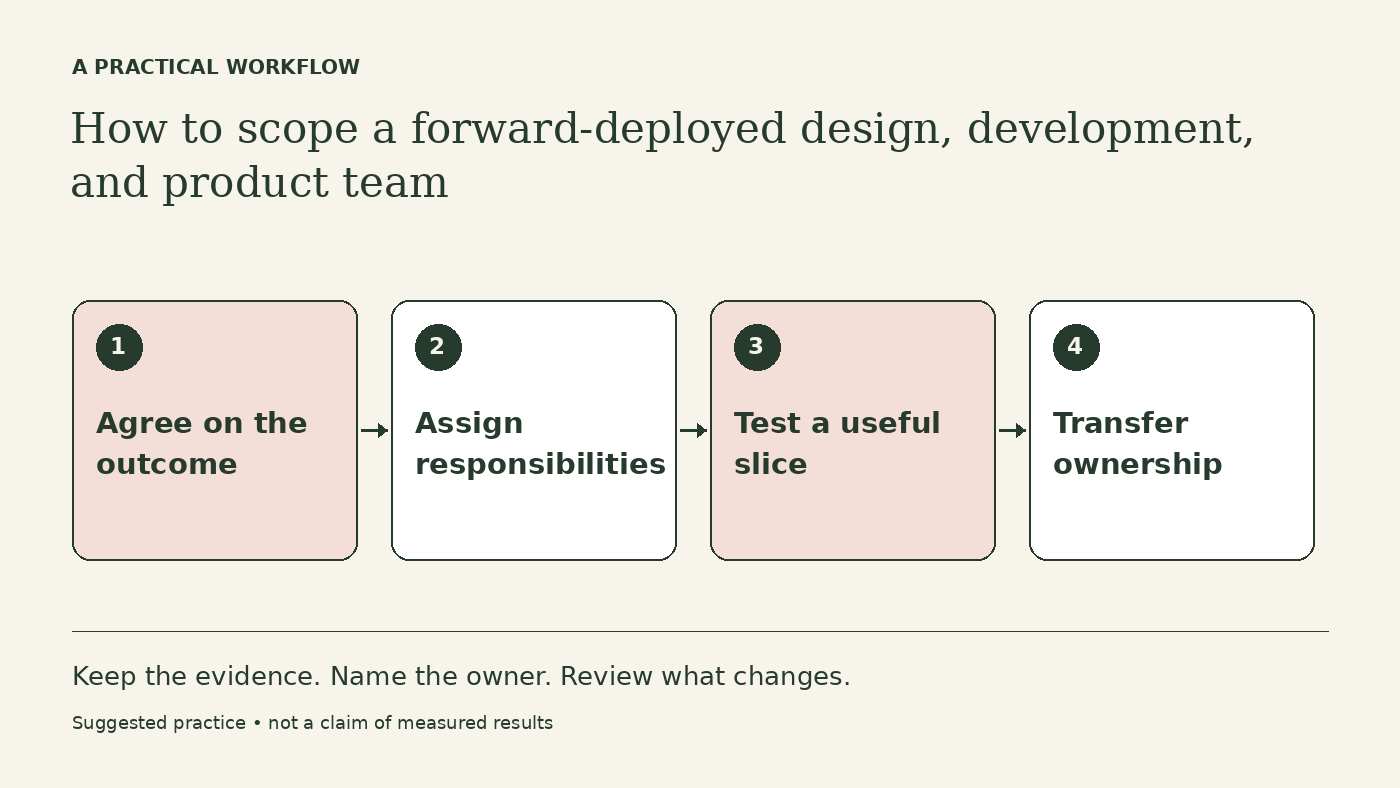 Embedded delivery
How to scope a forward-deployed design, development, and product team
Turn an ambiguous client implementation into a bounded engagement with clear responsibilities, evidence, and a useful handoff.
October 16, 2026 · 4 min read