Agile delivery
An agile client review for AI-assisted delivery: evidence, decisions, and next steps
Use a practical weekly review to keep client outcomes, design, engineering, and product decisions connected as delivery accelerates.
In this guide
- The useful starting point
- Send a decision brief before the meeting
- Open with the customer workflow
- A suggested 40-minute review
- Copy this review record
- Example: a new request changes the release
- Use AI for preparation and follow-through
- Judge the review by what it enables
- Build on the earlier guides
- Questions you might be asking
- Sources and further reading
The useful starting point
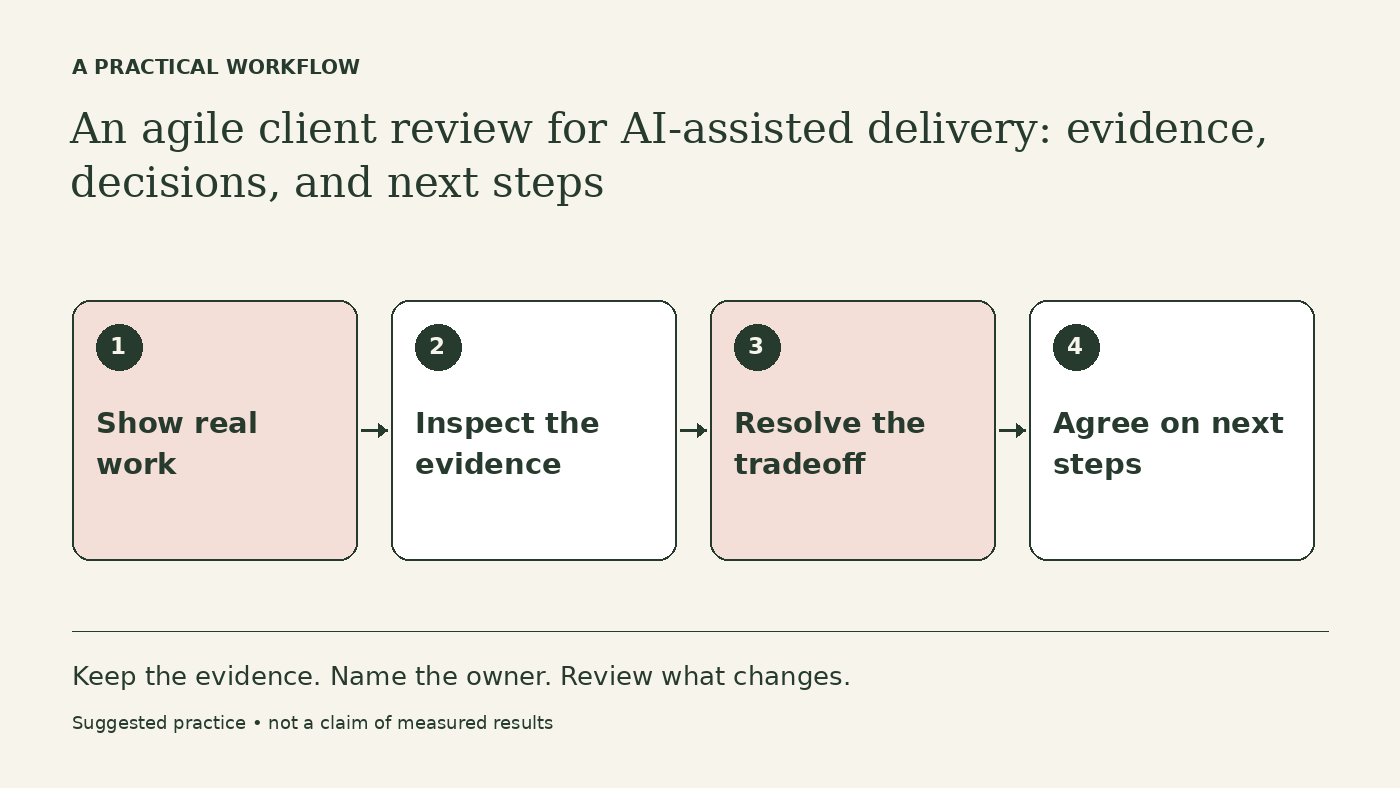
Review a real customer workflow, the evidence gathered, and the decisions needed. End with a clear next increment, accountable owners, and explicit changes to scope or acceptance.
AI can make a delivery team produce drafts and prototypes faster than a client can review them. The answer is not to bring a larger pile of output to the weekly meeting. The review should help both sides decide whether the work addresses the right problem and what should happen next.
This is a suggested client-review format for an embedded design, development, and product engagement. It can complement an existing agile practice. It is not a substitute for the full Scrum framework or for the commercial agreement that defines the engagement.
Send a decision brief before the meeting
Share a short description of the customer outcome, what changed since the last review, the evidence available, and the decisions you need from the client. Link to the actual artifact and keep unresolved questions visible.
Distinguish work that is ready for feedback from work that is ready for use. A prototype may be useful for examining a workflow while still lacking production data handling, accessibility validation, monitoring, or recovery behavior. State its status in language the client can understand.
Open with the customer workflow
Show what a person is trying to do and how the current increment changes that experience. Include an exception, such as an incomplete request or an unclear handoff. A smooth demonstration of the happy path can conceal the part of the workflow that creates the most customer frustration.
Ask the client to respond to the task and the observed behavior before discussing visual preferences or extra features. When a new request appears, capture the problem behind it so the team can evaluate alternatives.
A suggested 40-minute review
- First 5 minutes: restate the outcome. Confirm the goal, scope, and material changes in context.
- Next 10 minutes: inspect the increment. Walk through real behavior, the evidence gathered, and known limitations.
- Next 15 minutes: resolve the main decision. Compare options, consequences, and what remains uncertain.
- Next 5 minutes: agree on the next increment. Name the owner, dependency, and acceptance evidence.
- Final 5 minutes: read back changes. Confirm scope decisions, client responsibilities, and the review record.
These timeboxes are illustrative. If the meeting exposes an operational incident or a specialist question, route it to an appropriate working session rather than forcing a decision within the agenda.
Copy this review record
- Outcome: What customer or business improvement are we pursuing?
- Increment reviewed: What exists now, and where can the client inspect it?
- Evidence: Which observations support the direction, and which challenge it?
- Decision: What will we continue, change, defer, or stop?
- Scope impact: Does this replace planned work, add work, or change a constraint?
- Acceptance: What observable evidence will demonstrate the next increment is suitable?
- Owners and dates: Who supplies the missing input, performs the work, and approves the decision?
- Unresolved questions: What remains open, and how will we resolve it?
Share the record with the people responsible for follow-through. An AI-generated recap should be checked against the discussion before it is treated as an agreement.
Example: a new request changes the release
In a hypothetical engagement, a client reviews an AI-assisted intake workflow and asks for automatic customer emails. That request introduces a new action and a new review responsibility. The team discusses whether a reviewed draft is sufficient for the first release and what evidence would justify automatic sending later.
The review record captures the decision, the additional requirements, and the effect on the schedule. Faster prototype generation does not make these product and operational decisions disappear.
Use AI for preparation and follow-through
AI can organize approved notes, identify conflicting requirements, and draft the review record. Give it the original objective and source material. Require it to mark uncertain statements and avoid inventing agreement when participants expressed different views.
Keep a person responsible for commitments, scope changes, and release approval. If recording or transcription is used, follow the team's agreed consent and information-handling practices.
Judge the review by what it enables
Track whether decisions close, dependencies become visible early, and the next increment answers an important question. Watch for repeated carryover and late surprises. Counting how many AI-generated artifacts were produced does not tell you whether the client can use the result.
The Agile Manifesto supports frequent collaboration, while the Scrum Guide frames the Sprint Review around inspecting outcomes and adapting. This meeting template applies those ideas to a client engagement without making the meeting itself the goal.
Build on the earlier guides
- How to scope a forward-deployed design, development, and product team
- From process evaluation to a useful automation pilot
- Lead AI adoption across product, marketing, and delivery
Questions you might be asking
Is this a Sprint Review?
Only if it is part of your Scrum practice and serves that purpose. The template can also be used in other delivery approaches; it does not define Scrum by itself.
What if a client asks for extra work during the review?
Capture the underlying need, discuss the effect on scope and timing, and record an explicit decision before treating it as a new commitment.
Sources and further reading
Sources checked October 16, 2026. Tool features and plan availability can change; review the linked publisher documentation before connecting an account.
Put one idea to work
Bring one recurring workflow, its sources, and a clear owner to a focused implementation conversation.
Explore practical AI training →Explore more from Waymaker AgencyKeep practicing
 AI implementation
Is your business data ready for connected AI?
Assess a connected AI workflow through decision clarity, data definitions, permissions, review ownership, and a small verifiable pilot.
October 16, 2026 · 5 min read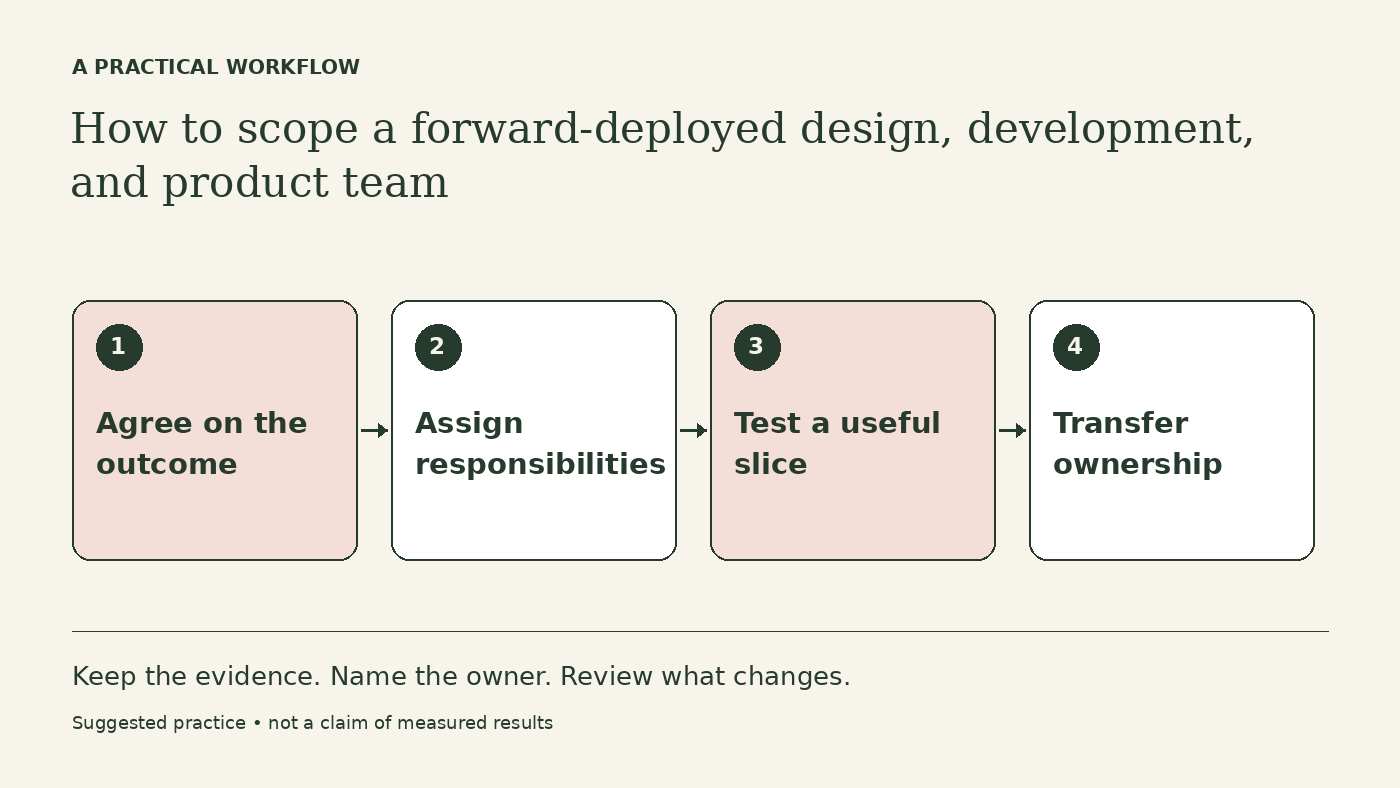 Embedded delivery
How to scope a forward-deployed design, development, and product team
Turn an ambiguous client implementation into a bounded engagement with clear responsibilities, evidence, and a useful handoff.
October 16, 2026 · 4 min read